Powerful History of Khilafat in Islam: 4 Great Caliphs
Introduction:
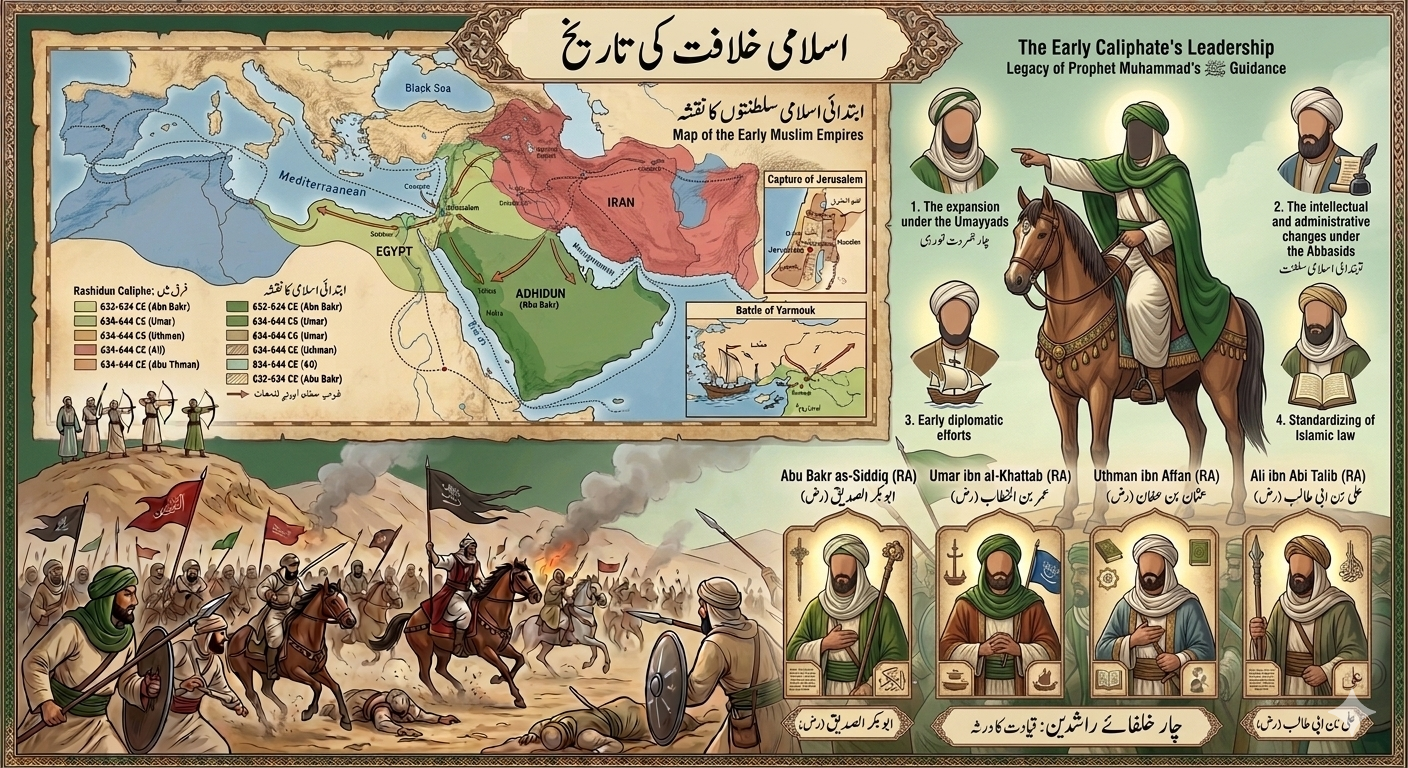
The History of Khilafat in Islam is an important part of Islamic civilization and leadership. After the passing of Prophet Muhammad ﷺ in 632 CE, Muslims needed a leader to guide the community according to the teachings of Islam. This leadership system was called Khilafat (Caliphate), and the leader was known as the Caliph (Khalifa).
The History of Khilafat in Islam begins with the Rashidun Caliphate, also known as the Rightly Guided Caliphs, who ruled with justice, wisdom, and strong adherence to Islamic principles. Understanding the History of Khilafat in Islam helps Muslims learn about governance, unity, and the spread of Islam across the world.
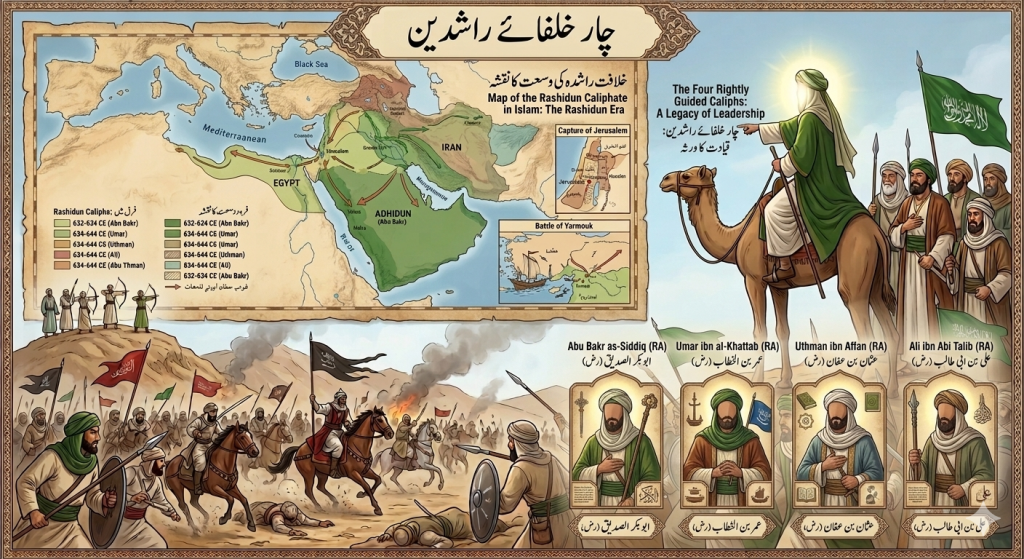
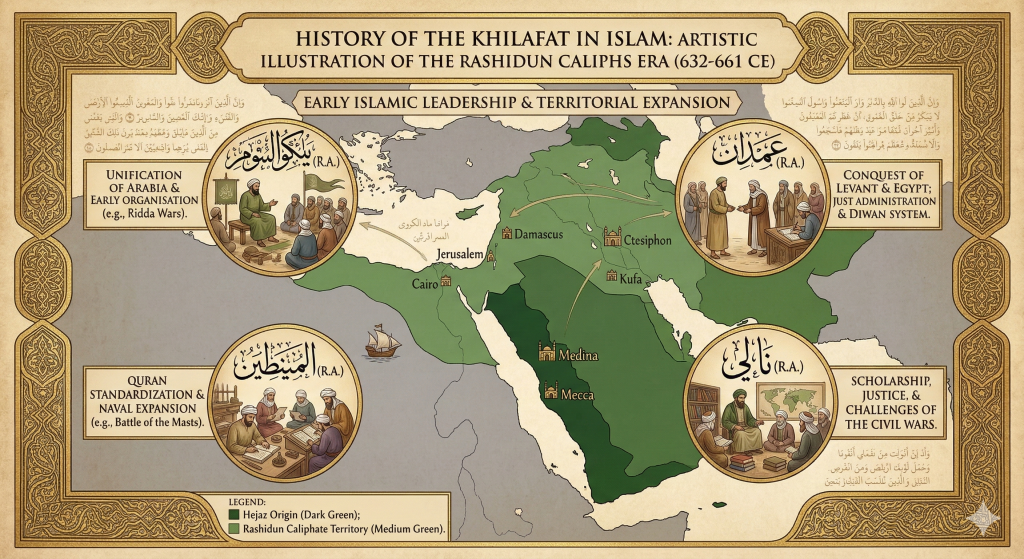
The First Caliph – Abu Bakr (RA)
When Prophet Muhammad ﷺ died, everyone picked Abu Bakr (RA) to be the first Caliph.
Key Achievements:
Got the Muslim community together as one.
Fought off rebels in the Ridda Wars.
Made sure the Quran was written down and saved.
Kept things stable in the early days.
He was in charge from 632–634 CE and really set the stage for a strong Islamic state.
The Second Caliph – Umar ibn Al-Khattab (RA)
Umar ibn Al-Khattab (RA) was the second Caliph, and people knew him for being fair and a strong leader.
Major Achievements:
He grew the Islamic empire into Persia, Syria, Egypt, and Iraq.
He set up how the Islamic government would work.
He started courts and ways to help people out.
He kicked off the Islamic calendar (Hijri calendar).
His time from 634–644 CE? Super successful for Islam.
The Third Caliph – Uthman ibn Affan (RA)
Uthman ibn Affan (RA), the third Caliph, was all about giving and being kind.
Important Contributions:
Making the Quran the same everywhere.
Building up the Islamic navy.
Expanding the land even more.
Building important stuff for people to use.
He was in charge from 644–656 CE, but things got messy, and he ended up getting killed because of political stuff.
The Fourth Caliph – Ali ibn Abi Talib (RA)
Ali ibn Abi Talib (RA), the fourth Caliph, was Prophet Muhammad’s ﷺ cousin and son-in-law.
Key Events:
He had to deal with people fighting within the Muslim community.
There were battles like Jamal and Siffin.
He pushed for fairness, knowledge, and being wise.
He made Islamic learning stronger.
He led from 656–661 CE, and that was the end of the Rashidun Caliphate.
Why the Rashidun Caliphate Matters
The history of the Khilafat during the Rashidun period? It’s like the best example of how to lead in Islam.
Lessons to Learn:
Be fair in how you run things.
Talk things over to make decisions (Shura).
Protect what your religion stands for.
Stay united as Muslims.
These four caliphs helped Islam spread far and wide while keeping morals high.
Khilafat After the Rashidun Period
After the Rashidun Caliphs, things changed. Here are some of the dynasties that took over:
Umayyad Caliphate (661–750 CE)
Capital was in Damascus.
They took over a lot of land.
Abbasid Caliphate (750–1258 CE)
Capital was in Baghdad.
This was a great time for Islamic science and culture.
Ottoman Caliphate (1299–1924)
The last caliphate that most people knew about.
It ended in 1924.
These times are really important in the history of the Khilafat in Islam too.
Multi-Language Section
الخلافة في الإسلام نظام قيادة للمسلمين بعد وفاة النبي محمد ﷺ.
Urdu
اسلام میں خلافت مسلمانوں کی قیادت کا نظام ہے جو نبی کریم ﷺ کے بعد قائم ہوا۔
Hindi
इस्लाम में खिलाफत मुसलमानों की नेतृत्व व्यवस्था है जो पैगंबर मुहम्मद ﷺ के बाद स्थापित हुई।
Bengali
ইসলামে খেলাফত হলো মুসলমানদের নেতৃত্ব ব্যবস্থা যা নবী মুহাম্মদ ﷺ এর মৃত্যুর পর প্রতিষ্ঠিত হয়।
Conclusion:
The History of Khilafat in Islam shows how Islamic leadership guided the Muslim community after the Prophet Muhammad ﷺ. The Rashidun Caliphs demonstrated justice, wisdom, and dedication to Islamic principles. Their leadership remains a model for Muslims today.
Studying the History of Khilafat in Islam helps believers understand the importance of unity, justice, and responsibility in leadership.