

Azan Ke Baad Ki Dua: Benefits & Sunnah Guide
What Is Azan Ke Baad Ki Dua?
The dua after azan (Azan Ke Baad Ki Dua ) is a beautiful Sunnah supplication recited immediately after hearing the call to prayer. Think of the Adhan as an invitation from Allah, and this dua as your loving response to that invitation. Every day, five times, the muezzin calls believers toward prayer, and Islam teaches that this moment is not ordinary it is spiritually loaded, almost like a door of mercy opening.
The famous supplication begins:
اللّهُمَّ رَبَّ هٰذِهِ الدَّعْوَةِ التَّامَّةِ وَالصَّلَاةِ الْقَائِمَةِ آتِ مُحَمَّدًا الْوَسِيلَةَ وَالْفَضِيلَةَ وَابْعَثْهُ مَقَامًا مَحْمُودًا الَّذِي وَعَدْتَهُ
Allahumma Rabba Hadhihid-Da‘watit-Tammah Was-Salatil-Qa’imah Ati Muhammadanil-Wasilata Wal-Fadilah Wab’athhu Maqaman Mahmoodanilladhi Wa‘adtah
This is not just a set of memorized words. It carries love for the Prophet ﷺ, hope for intercession, and recognition of Allah’s perfect call. According to Sahih al-Bukhari 614, whoever recites this after hearing the Adhan may receive the Prophet’s intercession on the Day of Resurrection.
Reciting azan ke baad ki dua after every Adhan brings immense rewards.
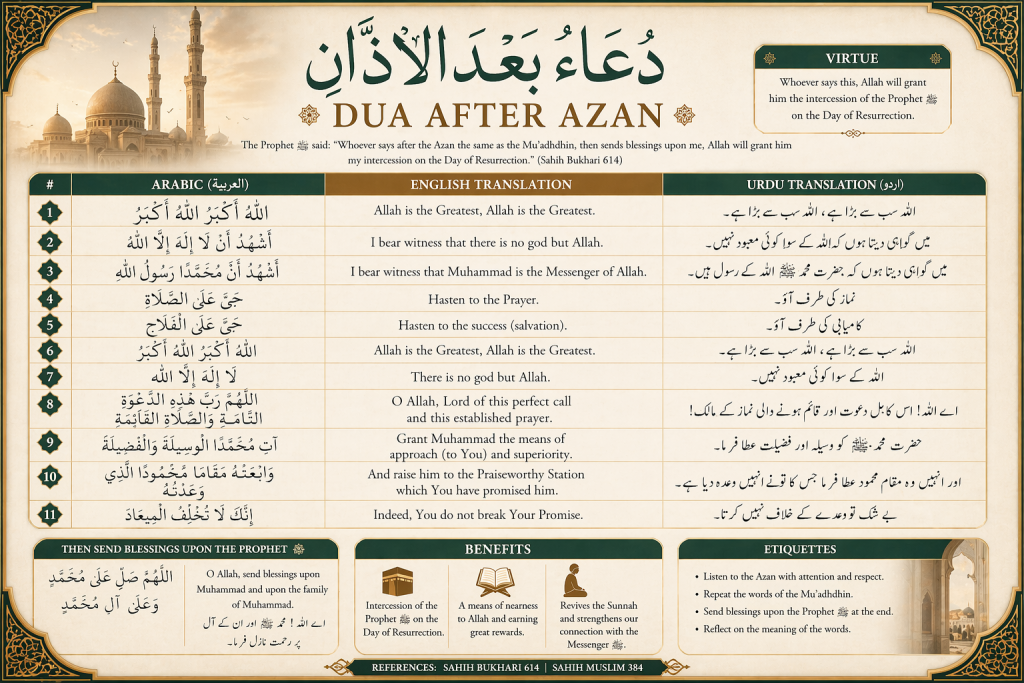
Full Dua After Azan in Arabic
The authentic dua after azan full is mentioned in Hadith with great virtue.
Arabic Text
اللَّهُمَّ رَبَّ هَذِهِ الدَّعْوَةِ التَّامَّةِ وَالصَّلَاةِ الْقَائِمَةِ آتِ مُحَمَّدًا الْوَسِيلَةَ وَالْفَضِيلَةَ وَابْعَثْهُ مَقَامًا مَّحْمُودًا الَّذِي وَعَدْتَهُ
Some people also recite:
إِنَّكَ لَا تُخْلِفُ الْمِيعَاد
Roman English Transliteration
Allahumma Rabba hadhihid-da‘watit-tammah, was-salatil qa’imah, ati Muhammadanil wasilata wal fadilah, wab‘athhu maqamam mahmudanilladhi wa‘adtah.
It may seem long at first, but with repetition it settles into the heart. Like a melody heard often enough, it becomes part of your spiritual rhythm.
Dua After Azan with English Translation
Translation:
“O Allah, Lord of this perfect call and the prayer about to be established, grant Muhammad the Wasilah and superiority, and raise him to the Praised Station You have promised him.”
Now pause and absorb those words.
- Perfect Call refers to the Adhan itself.
- Wasilah is a lofty rank in Paradise.
- Maqam Mahmood is the praised station promised to Prophet Muhammad ﷺ.
This dua is not asking for worldly wealth, status, or ease. It teaches something extraordinary we ask Allah to elevate His Messenger ﷺ. And in doing so, we ourselves are elevated.
That is the beauty of Islamic worship. Sometimes the path to blessing is praying for what Allah loves.
Authentic Hadith About Azan Ki Dua
The foundation of this supplication comes from authentic Hadith.
Narrated Jabir ibn Abdullah (RA):
The Prophet ﷺ said:
“Whoever says this when he hears the Adhan, my intercession will be permitted for him on the Day of Resurrection.”
Imagine that promise.
On a Day when humanity will desperately seek mercy, this simple daily Sunnah could be among the reasons for receiving the Prophet’s intercession.
That’s why scholars have always emphasized not treating this as optional background worship, but as a neglected treasure.
Hadith Rewards at a Glance
| Reward | Benefit |
| Prophet’s Intercession | Greatest spiritual reward |
| Following Sunnah | Earns love of Allah |
| Barakah in Prayer | Better focus in Salah |
| Accepted Supplications | Blessed time for dua |
| Increased Dhikr | Strengthens faith |
Another authentic narration teaches that duas between Adhan and Iqamah are not rejected.
So after finishing the Adhan dua(Azan Ke Baad Ki Dua), make personal dua too. That moment is golden.
What To Say During Azan Before This Dua
Many people jump straight to azan ke baad ki dua, but there is Sunnah before it too.

Repeat After the Muazzin
Respond to each phrase as the caller says it.
When he says:
- Allahu Akbar → Repeat it
- Ashhadu an la ilaha illallah → Repeat it
- Ashhadu anna Muhammadar Rasulullah → Repeat it
At:
Hayya alas-Salah
Hayya alal-Falah
Say:
La hawla wa la quwwata illa billah
This means:
“There is no power and no strength except through Allah.”
Beautiful, isn’t it?
The call invites you physically toward prayer, while this phrase reminds you spiritually that only Allah gives the strength to answer.
Then when Adhan ends, recite the famous dua.
This is the full Sunnah sequence many overlook.
Benefits of Reciting Dua After Azan
1. Intercession of the Prophet ﷺ
This is the most powerful virtue.
One short supplication. Five times a day.
Potential reward?
The Prophet’s intercession.
That is astonishing.
2. Love for the Messenger ﷺ Increases
Every time you ask Allah to elevate Prophet Muhammad ﷺ, your own bond with him deepens.
Love grows through remembrance.
3. Strengthens Prayer Connection
Salah no longer starts at “Allahu Akbar” in the prayer line.
It starts at the Adhan.
The believer begins preparing spiritually before prayer even starts.
4. A Neglected Sunnah Revived
Some acts are so easy people ignore them.
Yet neglected Sunnahs often carry enormous hidden reward.
Reviving them is like uncovering buried treasure.
5. Opportunity for Accepted Dua
Between Adhan and Iqamah is among the precious times when supplications are accepted.
Why waste such moments scrolling phones or chatting?
That window may be small but eternity can enter through small windows.
Common Mistakes People Make
Skipping It Completely
Many hear the Adhan and move on.
No response.
No dua.
No engagement.
That means missing reward daily.
Reciting Without Understanding
Words on the tongue but absent from the heart.
Understanding transforms routine into worship.
Wrong Pronunciation
Learn it properly.
Even slow recitation with care is better than rushed repetition.
Thinking There Is a Dua Before Adhan
Some search for azan se pehle ki dua, but scholars note there is no specific prescribed dua before the Adhan itself.
Important distinction.
Islam is preserved through authentic practice, not invented additions.
Azan Ke Baad Ki Dua with Urdu Meaning (Summary)
For readers looking for azan ke baad ki dua with urdu translation, its meaning includes:
یااللہ !اس کامل اعلان اور قائم ہونے والی نماز کے مالک، محمدۖ کو مقامِ وسیلہ عطا فرما اور ان کی فضیلت میں اضافہ فرما اور ان کو مقامِ محمود پر پہنچا جس کا تو نے ان سے وعدہ کیا ہے ۔
Every Muslim should know azan ki dua and recite it daily.
Conclusion
The dua after azan(Azan Ke Baad Ki Dua ) may be one of the simplest Sunnahs to practice and one of the most rewarding. It takes less than a minute, requires no special effort, and carries promises tied to intercession, mercy, and spiritual closeness.
Every Adhan is an invitation.
Every response is a chance.
Every repetition plants something in the soul.
So next time you hear:
Allahu Akbar…
Don’t let it pass like background sound.
Pause.
Respond.
Recite the dua.
And turn a daily moment into an eternal investment.
1. What is the full dua after azan?
It begins:
Allahumma Rabba hadhihid-da‘watit-tammah…
and ends:
…maqamam mahmudanilladhi wa‘adtah
Some add:
Innaka la tukhliful mi‘ad.
2. Is dua after azan mentioned in Sahih Hadith?
Yes. It is authentically reported in Sahih al-Bukhari 614.
3. What reward comes from reciting azan ki dua?
The Prophet ﷺ said his intercession becomes due for the person who recites it.
4. Can I make personal dua after azan?
Yes, especially between Adhan and Iqamah, as this is a blessed time for accepted supplications.
5. Is there a dua before azan?
There is no specific authentic prescribed dua before Adhan itself.