Surah Baqarah Last 2 Ayat: Complete Guide
Introduction to Surah Al-Baqarah.
Importance in the Quran
The longest chapter in the Quran is Surah Al-Baqarah which has 286 verses. It possesses a distinct and strong status in the Islamic teachings which is commonly known as a guide, law and spiritual guard. To Muslims all over the world, this Surah is not merely a chapter to read it is a detailed book of life. Still on issues of faith, social laws, all will be discussed in detail thereby rendering it very relevant even to this day.
The most important thing about this Surah is that it highlights the belief (Iman), obedience, and trust to Allah. Numerous researchers emphasize that the regular recitation of Surah Baqarah is a blessing and prevents a person from being interrupted by negative powers at home. It’s often recommended to recite it for protection, peace, and spiritual strength.
Structure and Ruku Overview
The surah Baqarah consists of 40 rukus, each depicting thematic parts. These rukus make the reader comprehend the Quran in the small bits that can be digested. Surah Baqarah, the final ruku of which, has some of the most forceful verses in the whole Quran, the most well-known of which are the last two ayat (verses 285,286).
These last verses give a recap of the main Islamic beliefs, faith in Allah, His angels, His books, His messengers and also highlight the mercy and justice of Allah. Knowing the Surah structure makes you realize the beauty with which the Surah ends with a message of hope, forgiveness, and Godly support.
What Are the Last 2 Ayat of Surah Baqarah?
Arabic Text Overview
Surah Baqarah last two verses are:
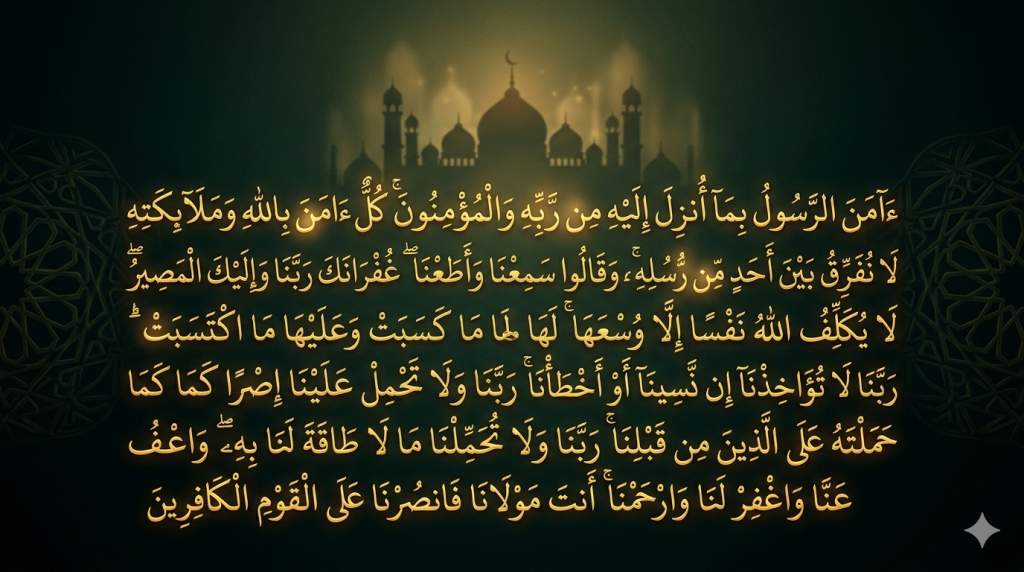
Ayat 285:
آمَنَ الرَّسُولُ بِمَا أُنزِلَ إِلَيْهِ مِن رَّبِّهِ وَالْمُؤْمِنُونَ ۚ كُلٌّ آمَنَ بِاللَّهِ وَمَلَائِكَتِهِ وَكُتُبِهِ وَرُسُلِهِ لَا نُفَرِّقُ بَيْنَ أَحَدٍ مِّن رُّسُلِهِ ۚ وَقَالُوا سَمِعْنَا وَأَطَعْنَا ۖ غُفْرَانَكَ رَبَّنَا وَإِلَيْكَ الْمَصِيرُ
Ayat 286:
لَا يُكَلِّفُ اللَّهُ نَفْسًا إِلَّا وُسْعَهَا ۚ لَهَا مَا كَسَبَتْ وَعَلَيْهَا مَا اكْتَسَبَتْ ۗ رَبَّنَا لَا تُؤَاخِذْنَا إِن نَّسِينَا أَوْ أَخْطَأْنَا ۚ رَبَّنَا وَلَا تَحْمِلْ عَلَيْنَا إِصْرًا كَمَا حَمَلْتَهُ عَلَى الَّذِينَ مِن قَبْلِنَا ۚ رَبَّنَا وَلَا تُحَمِّلْنَا مَا لَا طَاقَةَ لَنَا بِهِ ۖ وَاعْفُ عَنَّا وَاغْفِرْ لَنَا وَارْحَمْنَا ۚ أَنتَ مَوْلَانَا فَانصُرْنَا عَلَى الْقَوْمِ الْكَافِرِينَ
English Translation
Ayat 285
The Messenger has believed in what has been revealed to him by his Lord and so have the believers. They all trust in Allah, His angels, His books and His messengers. They say: We have no distinction among any of His messengers, and they say, we hear and we obey. Grant us Your forgiveness, our Lord, and to You is that which returns to Him.
Ayat 286
Allah never imposes on any soul more than it can handle. And against it is what it has done, and what it has deserved.
Our Lord, forgive us, should we forget or fail.
Lord Jesus, do not leave us with such a burden as that which Thou hast left those before us.
Our Lord, spare us that we cannot bear.
And forgive us, pardon us, and be merciful to us.
You are our Defender and come to our aid against the unbelieving folk.
Tafseer Surah Baqarah Final 2 Ayat.
1. No Struggle with Faith.
Mufti Shafi gives an explanation that this verse brings out a very special aspect of Muslims, that when the divine commands were revealed, they did not argue and defy. Instead, they said:
“We hear and we obey.”
The believers were fully submissive unlike the earlier countries that needed to inquire (Tasleem). This is shown as the right spirit of a true believer.
2. Unity in the belief in All Prophets.
The tafseer highlights that Muslims do not reject any prophets, they believe in all prophets starting with Adam (AS) up to Muhammad ﷺ. This is what differentiates Islam with the previous societies who believed in some prophets and rejected others.
3. Ayat 286 of the Dua is Divinely taught.
An important lesson of Maariful Qur’an is that the dua in this verse is taught by Allah himself. This means:
These are not just some common supplications.
They are flawlessly organized forgiveness, mercy and ease prayers.
It is as though Allah Himself is educating us on how to request of Him.
4. Allah Does not Overburden a Soul. Explaned.
Mufti Shafi explains a very significant point:
Always under human capacity are Shariah obligations.
However, thoughts that come involuntarily are not sinful
This came out when friends were concerned about being responsible of interior thoughts. Allah reassured them that:
The actions and choices can only be held accountable through intentional actions.
Uncontrollable thoughts are pardoned.
5. Three Levels of Forgiveness in the Dua
The dua in Ayat 286 includes three powerful requests:
اعفُ عنا (Pardon us) → eliminate sins altogether.
اغفر لنا (Forgive us) → cover our sins.
ارحمنا (Have mercy on us) → have abundant blessings instead of forgiveness.
Mufti Shafi points out that this indicates a complete healing process spiritually.
6. Guard against Troubled Trials.
There is also a request to the verse:
“Do not burden us like those before us”
The tafseer says:
Very (strict) laws were given to the previous nations.
Mercy and ease of the Ummah of Prophet ﷺ.
This dua protects against severe suffering.
7. A Complete Package of Faith + Dua.
Mufti Shafi concludes that either of the following two ayat put together:
Iman (belief)
Obedience
Accountability
Hope in Allah’s mercy
This is the reason why they are one of the most detailed and strong verses of the Quran.
Major Idea: “Allah Does not overburden a Soul.
This is a common expression of solace. Be it you are struggling with an economic hardship, emotional distress or anything about your life, this verse will remind you that your plight is not too great to bear.
Imagine it as a teacher that simply gives you a test that he/she is convinced that you will pass. Allah is the most merciful and he never tries you unjustly. This trust builds patience and fortitude into life.
The merits of Reciting Last 2 Ayat.
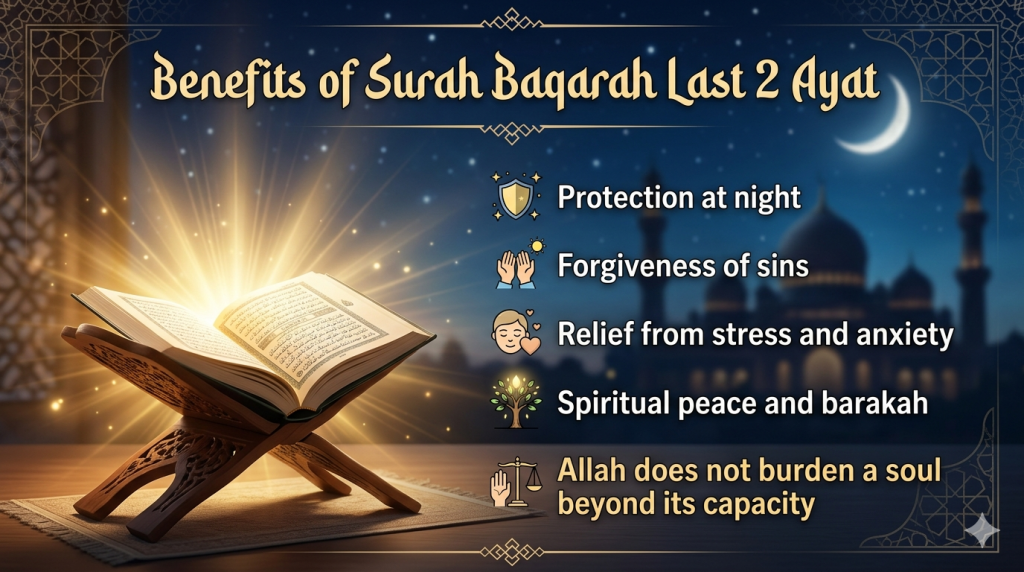
Protection at Night
It is recommended that these two verses be recited at night so that protection is provided. It is a protective cloak, which keeps you out of trouble, fear and the negative.
Forgiveness and Mercy
These verses include powerful supplications asking Allah for forgiveness. Routine recitation will make your heart soft and will strengthen your bond with Allah.
Hadith About Last Two Verses
The Prophet Muhammad (peace be upon him) said that whoever recites the last two verses of Surah Baqarah at night, they will be sufficient for him. This indicates their great significance in everyday life.
Surah Baqarah Last Ruku Overview
The final ruku is highly introspective, touching on faith, responsibility and the mercy of Allah. It is a unifying thread to the themes explored in the Surah, and concludes with hope and reassurance.
The number of Rukus in Surah Baqarah.
Surah Baqarah has 40 rukus, and this is the reason why it is one of the most elaborate Surahs with respect to its structure.
Daily Recitation: Practical Advice.
It does not need to be hard to form a habit of reciting these verses everyday. Begin small repeat them at bedtime. Audio may be used. With time you will remember them automatically.
Regularity is greater than frequency. These two verses will not consume more than a minute, yet the spiritual gains can be huge, even in a busy time.
Conclusion:
The last two ayat of Surah Baqarah are more than just verses they are a complete spiritual toolkit. They blend faith, wishing, hope and assurance in a manner that is heart touching. You are in need of protection, forgiveness, or peace of mind, these verses are all you need.
Having them as part of your everyday life can change your spiritual life. It is an easy habit that has great outcome.
1. What are the last two ayat of Surah Baqarah called?
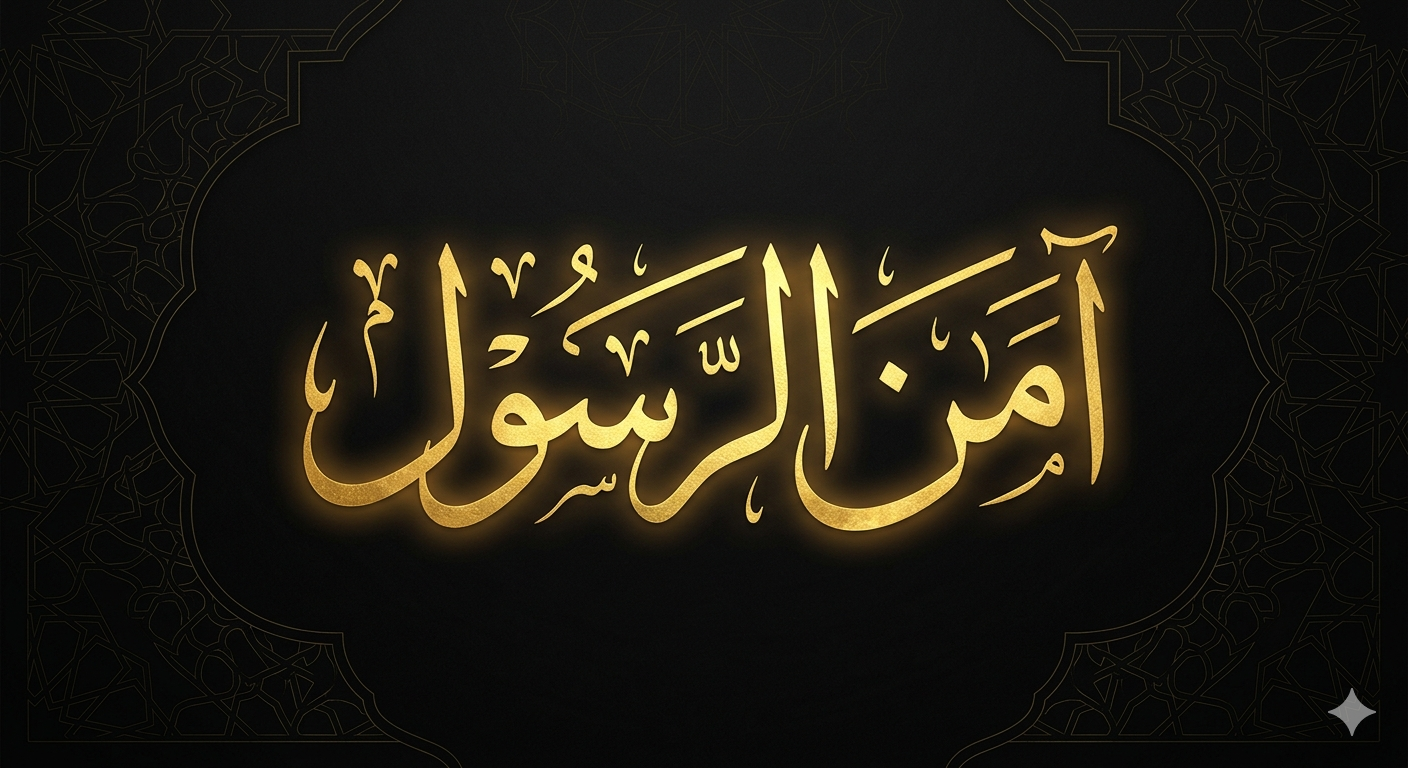
They are commonly known as “Amana Rasul” based on the opening words of verse 285.
2. What is the benefit of reciting them at night?
They provide protection and are sufficient for the night according to hadith.
3. Can I read them in English or Urdu?
Yes, but reciting in Arabic carries more reward. Understanding translation is also important.
4. How long does it take to memorize them?
With regular practice, most people can memorize them within a few days.
5. Are these verses part of daily prayers?
They are not mandatory in Salah but highly recommended for daily recitation.