
Darood e Ibrahimi – Complete Guide
What is Darood e Ibrahimi?
Darood e Ibrahimi is one of the most important supplications in Islam, recited by millions of Muslims across the world every single day. You’ve probably heard it during Salah, especially in the last sitting (Tashahhud). But have you ever paused and truly reflected on its depth and meaning?
At its core, Darood e Ibrahimi is a prayer that sends blessings upon Prophet Muhammad (PBUH) and Prophet Ibrahim (AS). It’s not just a ritual it’s a powerful connection between the believer and the Prophets. Think of it like sending a heartfelt message of gratitude and respect that carries immense spiritual weight.
Historical Background
The origin of Darood e Ibrahimi comes directly from authentic Hadith. The companions once asked Prophet Muhammad (PBUH) how they should send blessings upon him. In response, he taught them this exact wording. That’s why it holds such a high rank it’s not man-made; it’s divinely guided.
Importance in Islam
Darood e Ibrahimi is not optional in prayer it’s an essential part of Salah. Missing it intentionally can invalidate the prayer according to many scholars. Beyond that, reciting Darood brings peace to the heart, strengthens faith, and draws a person closer to Allah.
Full Darood e Ibrahimi Text
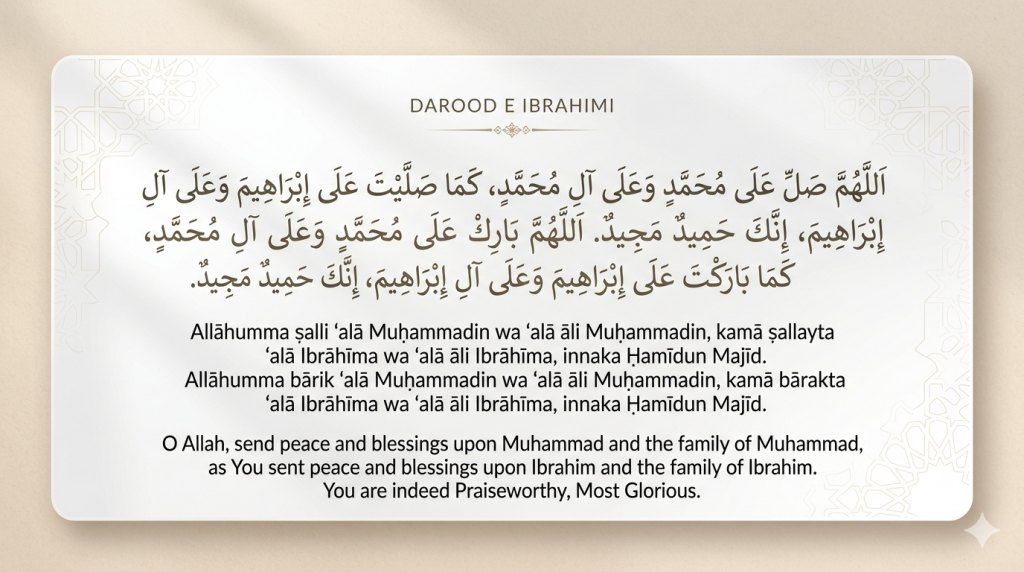
Darood e Ibrahimi in Arabic
اللَّهُمَّ صَلِّ عَلَى مُحَمَّدٍ وَعَلَى آلِ مُحَمَّدٍ
كَمَا صَلَّيْتَ عَلَى إِبْرَاهِيمَ وَعَلَى آلِ إِبْرَاهِيمَ
إِنَّكَ حَمِيدٌ مَجِيدٌ
اللَّهُمَّ بَارِكْ عَلَى مُحَمَّدٍ وَعَلَى آلِ مُحَمَّدٍ
كَمَا بَارَكْتَ عَلَى إِبْرَاهِيمَ وَعَلَى آلِ إِبْرَاهِيمَ
إِنَّكَ حَمِيدٌ مَجِيدٌ
Darood e Ibrahimi in English (Transliteration)
Allahumma salli ‘ala Muhammadin wa ‘ala aali Muhammadin
kama sallaita ‘ala Ibrahima wa ‘ala aali Ibrahima
innaka Hamidum Majid
Allahumma barik ‘ala Muhammadin wa ‘ala aali Muhammadin
kama barakta ‘ala Ibrahima wa ‘ala aali Ibrahima
innaka Hamidum Majid
Darood e Ibrahimi in Hindi
अल्लाहुम्मा सल्लि अला मुहम्मदिन व अला आली मुहम्मदिन
कमा सल्लैता अला इब्राहीम व अला आली इब्राहीम
इन्नका हमीदुम मजीद
अल्लाहुम्मा बारिक अला मुहम्मदिन व अला आली मुहम्मदिन
कमा बारकता अला इब्राहीम व अला आली इब्राहीम
इन्नका हमीदुम मजीद
Darood e Ibrahimi Translation (Tarjuma)
Urdu Translation
اے اللہ! محمد ﷺ پر اور آل محمد ﷺ پر رحمت نازل فرما،
جس طرح تو نے ابراہیم علیہ السلام اور آل ابراہیم علیہ السلام پر رحمت نازل فرمائی،
بے شک تو تعریف والا، بزرگی والا ہے۔
اے اللہ! محمد ﷺ پر اور آل محمد ﷺ پر برکت نازل فرما،
جس طرح تو نے ابراہیم علیہ السلام اور آل ابراہیم علیہ السلام پر برکت نازل فرمائی،
بے شک تو تعریف والا، بزرگی والا ہے۔
English Translation
“O Allah, send Your mercy upon Muhammad and the family of Muhammad,
as You sent Your mercy upon Ibrahim and the family of Ibrahim.
Indeed, You are Praiseworthy and Glorious.
O Allah, bless Muhammad and the family of Muhammad,
as You blessed Ibrahim and the family of Ibrahim.
Indeed, You are Praiseworthy and Glorious.”
Benefits (Fazilat) of Darood e Ibrahimi
Spiritual Rewards
Reciting Darood e Ibrahimi is like planting seeds of نور (light) in your heart. Each recitation brings countless blessings. According to Hadith, when you send one blessing upon the Prophet, Allah sends ten blessings upon you. Imagine that multiplication it’s like a spiritual investment with guaranteed returns.
Daily Life Benefits
People often overlook how deeply this simple recitation can impact daily life. Regular recitation can:
- Reduce stress and anxiety
- Bring peace of mind
- Increase رزق (sustenance)
- Strengthen your connection with Allah
It’s like a shield quietly protecting and uplifting you throughout the day.
Hadith References
The Prophet (PBUH) said:
“Whoever sends blessings upon me once, Allah sends blessings upon him ten times.”
This Hadith alone highlights the immense value of Darood.
When to Recite Darood e Ibrahimi
During Salah
Darood e Ibrahimi is recited in the final sitting of every prayer. This is where it becomes obligatory and central to the completion of Salah. Skipping it intentionally is not something to take lightly.
Daily Routine
Outside Salah, there’s no limit. You can recite it:
- After Fajr
- Before sleeping
- While walking or working
Think of it as a spiritual companion always accessible, always beneficial.
Common Mistakes While Reciting
Even though Darood e Ibrahimi is widely known, small pronunciation errors are common. These include:
- Mispronouncing “Ibrahim”
- Skipping words unknowingly
- Rushing through recitation
Accuracy matters because every word carries meaning.
Tips to Memorize Darood e Ibrahimi Easily
Memorizing might seem difficult at first, but it’s actually quite manageable if you approach it smartly.
Break it into smaller parts. Repeat each line slowly. Listen to recitations daily. Use repetition like a rhythm your brain loves patterns. Within a few days, you’ll notice it becoming second nature.
Darood e Ibrahimi in Different Languages
Hindi Version
The Hindi version helps non-Arabic speakers connect emotionally with the meaning. It bridges the gap between understanding and recitation.
English Transliteration
Transliteration is especially useful for beginners. It acts like training wheels helping you pronounce correctly until you’re comfortable with Arabic.
Role of Darood in Strengthening Faith
Darood e Ibrahimi isn’t just words it’s a reflection of love for the Prophet (PBUH). And in Islam, love for the Prophet is directly connected to faith.
The more you recite, the stronger that connection becomes. It’s like watering a plant slowly but surely, your Imaan grows deeper and stronger.
Conclusion
Darood e Ibrahimi is far more than a prayer recited in Salah. It’s a powerful spiritual tool that connects you with Allah and His beloved Prophets. Whether you recite it in Arabic, English, or Hindi, the essence remains the same sending blessings, gaining blessings, and nurturing your faith.
Make it part of your daily life, not just your نماز. Even a few moments of sincere recitation can transform your heart in ways you never expected.
1. Is Darood e Ibrahimi mandatory in Salah?
Yes, it is an essential part of the final sitting in prayer.
2. Can I read Darood in English or Hindi?
For learning, yes. But in Salah, Arabic is required.
3. How many times should I recite it daily?
There’s no fixed number. Even a few sincere recitations are valuable.
4. What is the best time to recite Darood?
Anytime, especially on Fridays and after prayers.
5. Does Darood remove difficulties?
Yes, many scholars mention its role in easing hardships and bringing blessings.