Surah Alam Nashrah in English – Translation, Meaning & Benefits (Chapter 94)
There are moments in life when the weight feels too heavy to carry. When you are exhausted spiritually, emotionally, or physically — and relief feels impossibly far away. It is in exactly those moments that Surah Alam Nashrah speaks most directly to the heart.
Eight verses. That is all. Yet within those eight verses, Allah reminds His Prophet ﷺ — and through him, every believer who will ever live — that hardship is never the final word. Ease always follows. Always.
If you are looking for Surah Alam Nashrah in English — its full translation, meaning, Arabic text, and spiritual benefits — this guide covers everything in one place.
What Is Surah Alam Nashrah?
Surah Alam Nashrah (also written as Surah Al-Nashrah) is the 94th chapter of the Holy Quran. It consists of just 8 verses and is found in the 30th Juz (Para). It was revealed in Makkah, during one of the most emotionally difficult periods in the life of Prophet Muhammad ﷺ.

The surah is known by several names:
| Name | Meaning |
| Alam Nashrah | “Did We not expand” — from its opening words |
| Surah Al-Inshirah | The Opening Up / The Expansion |
| Surah Ash-Sharh | The Relief / The Explanation |
| Surah Al-Nashrah | Another variant of the same title |
All of these names point to the same central theme: the opening of the chest, the lifting of burdens, and the promise of relief after difficulty.
When Was Surah Alam Nashrah Revealed?
Surah Alam Nashrah was revealed in Makkah, shortly after Surah Ad-Duha. Both surahs were revealed during the same period and address the Prophet ﷺ directly — a period when he was facing intense personal hardship, rejection from his own community, and the heavy weight of his prophetic mission. Together, Surah Ad-Duha and Surah Alam Nashrah form a pair of divine consolation, reminding the Prophet ﷺ that he was not alone and that Allah’s support was constant.
Surah Alam Nashrah in English – Full Translation with Arabic and Transliteration
Below is the complete Surah Alam Nashrah with Arabic text, Roman English transliteration, and English translation, verse by verse.
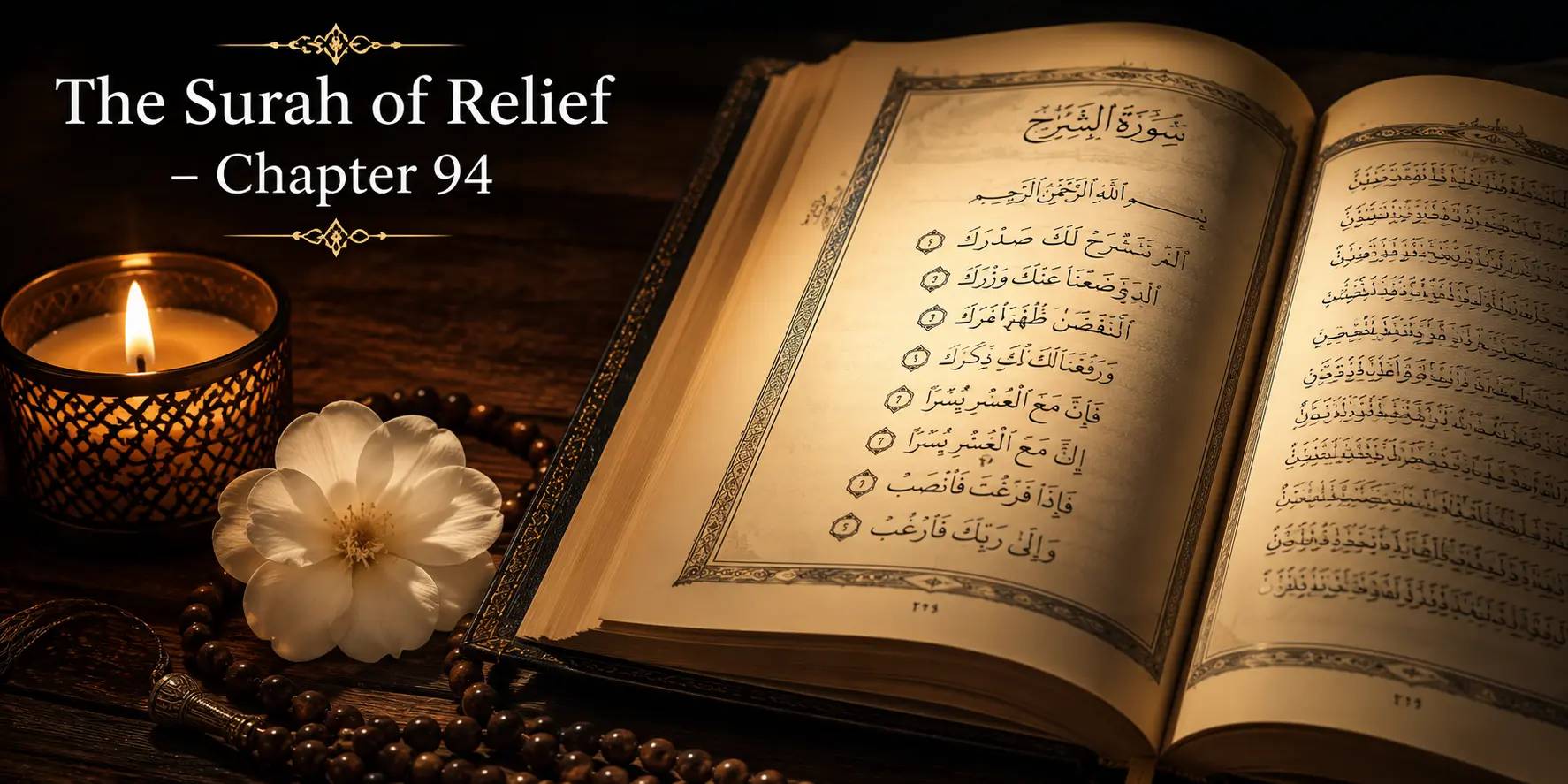
بِسْمِ اللَّهِ الرَّحْمَٰنِ الرَّحِيمِ
Bismillahir Rahmanir Raheem In the name of Allah, the Most Gracious, the Most Merciful.
Verse 1 أَلَمْ نَشْرَحْ لَكَ صَدْرَكَ
Alam nashrah laka sadrak
“Did We not expand your chest for you?”
This opening verse is rhetorical — Allah is not asking a question; He is reminding. He expanded the Prophet’s ﷺ chest, meaning He gave him peace, understanding, clarity, and the spiritual capacity to carry the immense responsibility of prophethood. For believers, this verse carries a personal message too: Allah can open any chest weighed down by anxiety, grief, or confusion.
Verse 2 وَوَضَعْنَا عَنكَ وِزْرَكَ
Wa wada’na ‘anka wizrak
“And We removed from you your burden.”
The word wizr in Arabic means a heavy, crushing burden — not just a physical weight but an emotional and spiritual one. Allah lifted that from His Prophet ﷺ. This verse is a reminder that when we turn to Allah, He does not merely reduce our burdens — He removes them.
Verse 3 الَّذِي أَنقَضَ ظَهْرَكَ
Alladhee anqada zahrak
“The one that had weighed heavily upon your back.”
This verse elaborates on the previous one — describing just how heavy that burden was. The Arabic anqada suggests the sound of something cracking under weight, like the groan of a back straining beneath too heavy a load. Allah acknowledges the severity of what His Prophet ﷺ carried before giving him relief.
Verse 4 وَرَفَعْنَا لَكَ ذِكْرَكَ
Wa rafa’na laka dhikrak
“And We raised high for you your repute.”
Allah elevated the Prophet’s ﷺ name and honor. His name is recited in every adhan (call to prayer), in every salah, and by over a billion Muslims every single day across the world. No other name in human history has been spoken as often, in as many languages, across as many centuries. This was Allah’s doing — a divine elevation that no worldly force could have achieved.
Verse 5 فَإِنَّ مَعَ الْعُسْرِ يُسْرًا
Fa inna ma’al ‘usri yusra
“For indeed, with hardship comes ease.”
This is perhaps the most quoted verse of this surah — and one of the most beloved verses in the entire Quran. The Arabic is precise: ma’a means “with”, not “after.” Ease does not merely follow hardship — it comes alongside it. Even in the darkest moment, the seed of relief is already present.
Verse 6 إِنَّ مَعَ الْعُسْرِ يُسْرًا
Inna ma’al ‘usri yusra
“Indeed, with hardship comes ease.”
The repetition is intentional and significant. In Arabic, when a definite noun (al-‘usr — the hardship, with the article “al”) is repeated, it refers to the same single hardship. But when an indefinite noun (yusra — ease, without the article) is repeated, it refers to two separate eases. Scholars have reflected on this deeply: one hardship, but two eases. The promise is generous, deliberate, and repeated for emphasis.
Verse 7 فَإِذَا فَرَغْتَ فَانصَبْ
Fa idha faraghta fansab
“So when you have finished your duties, then stand up for worship.”
After the promise of ease, Allah gives a direction: do not become idle in the good times. When one task is complete, turn immediately toward worship and devotion. The believer’s life is a continuous cycle — work, then worship; effort, then return to Allah. This verse teaches that the good times are not for rest from Allah — they are for deeper connection with Him.
Verse 8 وَإِلَىٰ رَبِّكَ فَارْغَب
Wa ila rabbika farghab
“And direct your longing toward your Lord.”
The surah closes with the most important instruction of all: let your deepest desire, your ultimate longing, be directed toward Allah alone. Not toward comfort, or success, or the relief of hardship — but toward Allah Himself. Everything else — ease, honor, the lifting of burdens — is a means. He is the destination.
Surah Alam Nashrah in Urdu
Surah Alam Nashrah ka Urdu tarjuma:
آیت 1: کیا ہم نے آپ کا سینہ نہیں کھول دیا؟
آیت 2: اور ہم نے آپ پر سے آپ کا بوجھ اتار دیا۔
آیت 3: جس نے آپ کی پیٹھ توڑ دی تھی۔
آیت 4: اور ہم نے آپ کا ذکر بلند کر دیا۔
آیت 5: تو بے شک تکلیف کے ساتھ آسانی ہے۔
آیت 6: بے شک تکلیف کے ساتھ آسانی ہے۔
آیت 7: پس جب آپ فارغ ہوں تو عبادت میں لگ جائیں۔
آیت 8: اور اپنے رب کی طرف رغبت کریں۔
What Is the Main Message of Surah Alam Nashrah?
The message of this surah moves through three clear stages:
Stage 1 — Remembering Allah’s Blessings Verses 1–4 remind the Prophet ﷺ (and through him, every believer) of what Allah has already given: an open chest, a lifted burden, an elevated name. Before addressing the present struggle, Allah draws attention to the blessings already in place. This is a spiritual strategy: gratitude shifts perspective before relief even arrives.
Stage 2 — The Promise of Ease Verses 5–6 deliver the central promise, repeated twice: with hardship comes ease. Not eventually. Not maybe. With — present, accompanying, certain. The repetition is not redundancy; it is emphasis. Allah wants the believer to be absolutely sure.
Stage 3 — The Direction Forward Verses 7–8 tell the believer what to do with this understanding: finish your work, then worship. And ultimately — direct all your longing toward Allah. This closing instruction transforms the surah from comfort into action.
Why Is Surah Alam Nashrah (Surah Inshirah) So Important?
It Was Revealed for a Moment of Real Hardship
Surah Alam Nashrah was not revealed in the comfortable years of the Prophet’s ﷺ mission. It came during the early Makkan period — a time of mockery, social rejection, and deep personal difficulty. The context matters because it means this surah was not theoretical comfort. It was divine response to a real and painful situation. And that same quality makes it deeply relevant to anyone facing a real and painful situation today.
The Promise Is Mathematically Generous
Arabic grammar scholars have long noted the linguistic structure of verses 5 and 6. The word for hardship (al-‘usr) carries the definite article — it refers to one specific hardship. The word for ease (yusra) has no definite article — which in Arabic implies a new, separate instance each time. One hardship. Two eases. The promise is not just comfort — it is abundance.
It Is a Surah of Action, Not Just Consolation
Unlike surahs that only offer comfort, Surah Alam Nashrah ends with a directive. Verses 7 and 8 push the believer forward: finish your task, worship, and turn your longing toward Allah. This prevents the surah from becoming passive — it transforms relief into motivation.
Benefits of Surah Alam Nashrah
Muslims who recite and reflect on Surah Alam Nashrah regularly describe consistent spiritual benefits:

1. Comfort During Anxiety and Stress The promise “with hardship comes ease” — repeated twice in one breath — is one of the most powerful stress-relieving statements in spiritual literature. Regular recitation reminds the heart of this truth before the mind forgets it.
2. Strengthening Trust in Allah The surah opens with Allah reminding the Prophet ﷺ of specific blessings He gave him. For the believer who reflects, it becomes a practice of recognizing one’s own blessings — which naturally deepens tawakkul (trust in Allah).
3. Motivation During Difficulty The combination of divine promise (verses 5–6) and divine instruction (verses 7–8) makes this surah uniquely motivating. It does not only say “things will be okay” — it says “things will be okay, now here is what you do.”
4. A Reminder of Elevated Status Verse 4 reminds us that Allah elevates the status of those who remain sincere. This is particularly comforting to those who feel unseen, unappreciated, or overlooked in their worldly circumstances.
5. Spiritual Balance Between Work and Worship Verse 7 carries a practical lesson that is easy to miss: balance your worldly duties with your spiritual ones. When you finish one, turn to the other. This surah teaches a rhythm of life that prevents both burnout and neglect of faith.
Important note: Some specific claims about Surah Alam Nashrah — such as curing particular illnesses or guaranteeing material wealth — are not supported by authentic (sahih) hadith. The surah’s spiritual benefits are well established through the Quran itself and its themes; claimed physical or material benefits should be understood as folk tradition rather than authenticated Islamic teaching.
Surah Alam Nashrah and Surah Ad-Duha — A Divine Pair
Scholars have long noted that Surah Alam Nashrah and Surah Ad-Duha (Chapter 93) form a connected pair. Both were revealed in Makkah during the same period, both address the Prophet ﷺ directly, and both carry the same essential message: Allah has not abandoned you, and your future will be better than your past.
Many scholars have even suggested they be recited together as a pair, because their messages flow naturally into each other — Surah Ad-Duha begins the consolation, and Surah Alam Nashrah deepens and completes it.
How to Memorize Surah Alam Nashrah
With only 8 short verses, Surah Alam Nashrah is one of the most accessible surahs for memorization:
Step 1: Start with verses 5 and 6 — the repeated promise. These two are nearly identical and the easiest to memorize first.
Step 2: Memorize verses 1–4 — the blessings Allah reminds the Prophet ﷺ of. Read each verse with its meaning so the words carry weight, not just sound.
Step 3: Finish with verses 7–8 — the closing instructions. These are short, direct, and easy to retain.
Practical method:
- Recite the surah 5 times after Fajr and 5 times before sleeping
- Read the English translation alongside Arabic for the first week
- Write out the transliteration by hand — muscle memory accelerates memorization