Surah Yaseen in English – Full Translation & Benefits (Chapter 36)
There is a reason Surah Yaseen is recited more than almost any other chapter of the Quran at gatherings, in hospital rooms, on Friday mornings, and beside loved ones who have passed. It has earned a name few other surahs carry: the Heart of the Quran.
If you are searching for Surah Yaseen in English to understand its meaning, not just recite its sound, this guide walks you through the full translation, its themes, and why it holds such a central place in Muslim life.
What Is Surah Yaseen?
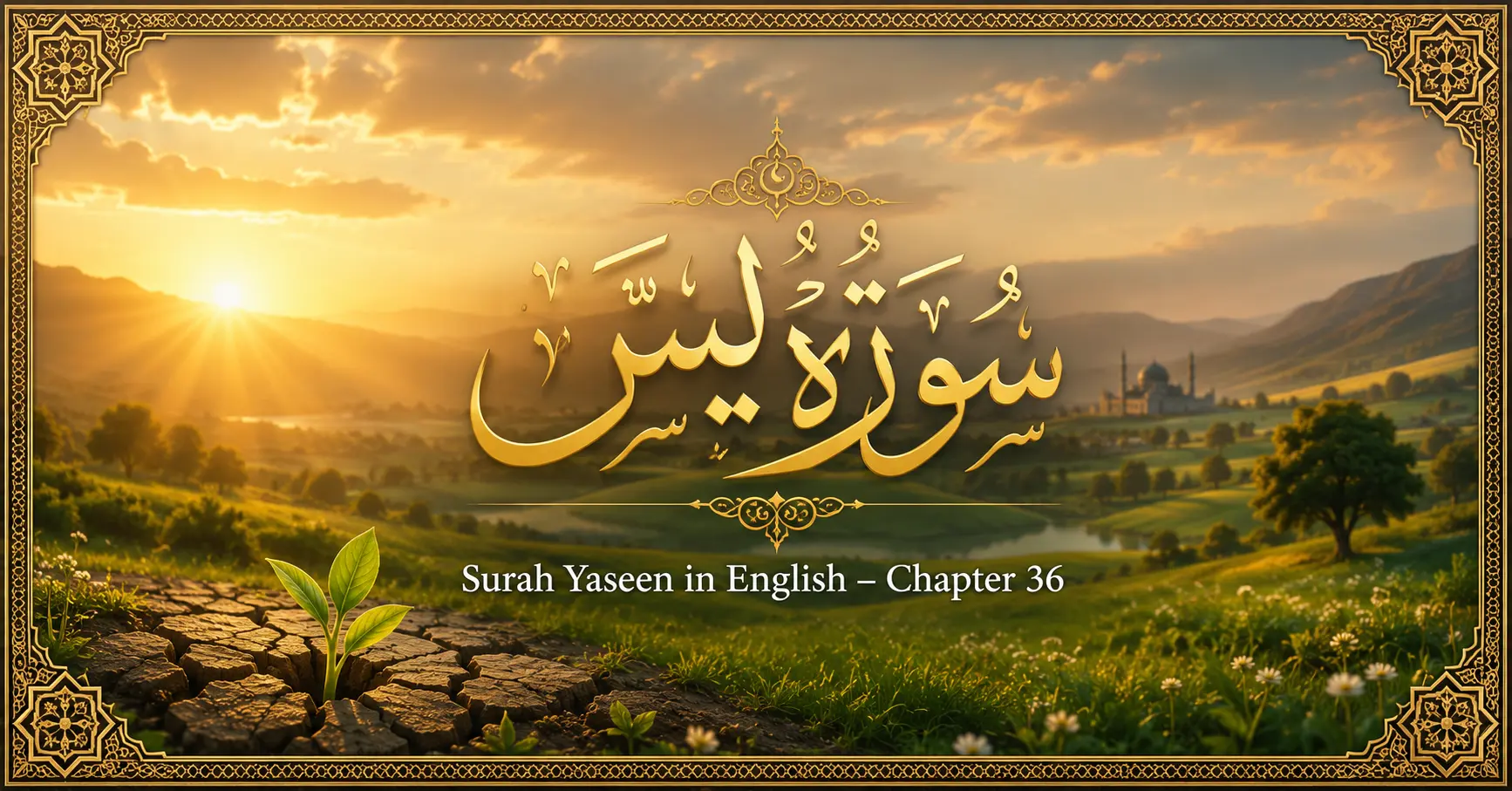
Surah Yaseen (also written Ya-Sin) is the 36th chapter of the Quran, made up of 83 verses. It was revealed in Makkah, during a period when the early Muslim community faced rejection and hardship. Its central message responds directly to that moment: it defends the truth of Prophet Muhammad’s ﷺ message, affirms life after death, and reassures believers that nothing about their struggle goes unseen by Allah.
The surah opens with two mysterious Arabic letters — Ya and Seen — whose precise meaning is known only to Allah. Several chapters of the Quran begin this way, and scholars have long reflected on their significance without claiming certainty.
Why Is Surah Yaseen Called the Heart of the Quran?
This title comes from a well-known narration in which the Prophet ﷺ described the Quran as having a heart, and that heart is Yaseen. Scholars explain this is because the surah contains, in concentrated form, the core beliefs of Islam the oneness of Allah, the truth of prophethood, and the certainty of resurrection. Just as a heart sustains the whole body, this surah carries the pulse of the Quran’s central message.
It’s worth noting that some of the specific hadith about its extra reward are considered weak by hadith scholars, even though the surah’s spiritual weight and central themes are well established and undisputed.
Surah Yaseen in English – Full Translation
Below is the complete Surah Yaseen in English, organized into sections so you can read with understanding rather than rushing through it.
Verses 1–12: The Qur’an’s Wisdom and the Warning
In the name of Allah, the Most Gracious, the Most Merciful.
Ya. Seen. By the wise Quran, you are truly one of the messengers, sent on a straight path — a revelation from the Almighty, the Merciful, so that you may warn a people whose forefathers were never warned, leaving them heedless. The verdict has already been proven true against most of them, for they do not believe.
We have placed shackles around their necks up to their chins, so their heads are forced upward. And We have placed a barrier before them and a barrier behind them, and We have covered them, so they do not see. It is the same to them whether you warn them or do not warn them — they will not believe.
You can only truly warn one who follows the reminder and fears the Most Merciful unseen. Give such a person good news of forgiveness and a generous reward. Indeed, it is We who bring the dead to life, and We record what they sent forth and what they left behind. Everything We have counted in a clear register.
Verses 13–32: The Parable of the Town and Its Messengers
Present to them the example of the people of a town to whom messengers came. We sent two messengers, but the people denied them, so We strengthened them with a third. They said, “We have truly been sent to you.” The people replied, “You are nothing but humans like us. The Most Merciful has not revealed anything — you are simply lying.”
The messengers said, “Our Lord knows that we have indeed been sent to you. Our duty is only to deliver the message clearly.” The people said, “We see an ill omen in you. If you do not stop, we will surely stone you, and a painful punishment from us will touch you.” The messengers replied, “Your bad omen is with yourselves. Is it because you were reminded? Truly, you are a transgressing people.”
Then a man came running from the farthest part of the city, saying, “O my people, follow the messengers. Follow those who ask no reward of you, and who are rightly guided. Why should I not worship the One who created me, and to whom you will all be returned? Should I take other gods besides Him? If the Most Merciful intends harm for me, their intercession will not help me at all, nor can they save me. Indeed, I would then be in clear error. I have believed in your Lord, so listen to me.”
It was said to him, “Enter Paradise.” He said, “If only my people knew how my Lord has forgiven me and placed me among the honored.”
After him, We did not send down upon his people any host from the heaven, nor did We need to. It was only one blast, and suddenly they were extinguished. How regretful for the servants — no messenger ever came to them except that they mocked him. Do they not see how many generations We destroyed before them, none of whom will ever return to them? Yet all of them, together, will be brought before Us.
Verses 33–44: Signs in Creation
A sign for them is the dead earth — We bring it to life and bring forth from it grain, from which they eat. And We placed in it gardens of palm trees and grapevines, and We caused springs to gush forth within it, so that they may eat of its fruit. Their hands did not make this — so will they not be grateful?
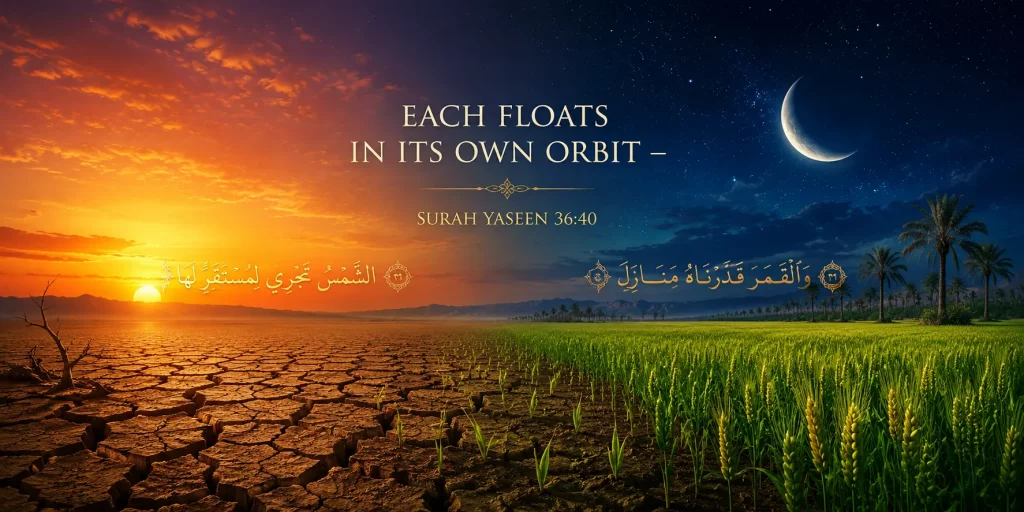
Glory be to the One who created all things in pairs — from what the earth grows, from themselves, and from things they do not even know. And a sign for them is the night: We strip the day from it, and suddenly they are in darkness. The sun runs its course to a fixed destination set by the Almighty, the All-Knowing. And the moon — We have ordained for it phases, until it returns like an old, curved palm stalk.
It is not for the sun to overtake the moon, nor does the night outrun the day. Each floats in its own orbit. And a sign for them is that We carried their forefathers in the laden ship, and We created for them similar things to ride upon. If We willed, We could drown them, with no one to answer their cry, and they would not be saved — except by mercy from Us, and enjoyment for a while.
When it is said to them, “Beware of what is before you and what is behind you, so that you may receive mercy” — they turn away from every sign their Lord sends them.
Verses 45–54: The Coming Hour
When it is said to them, “Spend from what Allah has provided you,” the disbelievers say to the believers, “Should we feed those whom Allah could feed if He willed? You are clearly mistaken.” They say, “When will this promise come, if you are truthful?” They await nothing but a single blast, which will seize them while they are arguing among themselves.
They will not even be able to make a will, nor return to their own people. The Horn will be blown, and suddenly they will rise from their graves, rushing to their Lord. They will say, “Woe to us — who has raised us from our resting place?” This is what the Most Merciful promised, and the messengers spoke the truth. It will be but one blast, and they will all be gathered before Us. So on that Day, no soul will be wronged in the slightest, and you will only be repaid for what you used to do.
Verses 55–67: The People of Paradise and the People of Fire
Indeed, the companions of Paradise that Day will be busy in joyful occupation. They and their spouses will be in shade, reclining on couches. They will have fruit therein, and whatever they request. “Peace” — a word from a Merciful Lord.
And He will say, “Stand apart today, O guilty ones. Did I not enjoin upon you, O children of Adam, that you should not worship Satan — for he is a clear enemy to you — and that you should worship Me? This is the straight path. He has already led astray a great many of you. Did you not understand?”
“This is the Hellfire you were promised. Enter it today for your disbelief.” On that Day, We will seal their mouths, and their hands will speak to Us, and their feet will testify to what they used to earn. If We willed, We could have erased their sight, and they would race toward the path, but how could they see? And if We willed, We could have transformed them in their places, so they could neither move forward nor turn back.
Verses 68–70: A Reflection on Old Age and the Quran
Whoever We grant a long life, We reverse him in creation. So will they not understand? We did not teach the Prophet poetry, nor is it fitting for him. This is only a reminder and a clear Quran — to warn whoever is alive, so that the word may be proven true against the disbelievers.
Verses 71–76: Reflecting on the Blessings of Creation
Do they not see that We have created for them, among what Our hands have made, livestock which they own? We have subjected these animals to them — some they ride, and of some they eat. They have other benefits from them too, and drinks. So will they not be grateful? Yet they have taken gods besides Allah, hoping they might be helped. These gods cannot help them — though they stand ready as soldiers for them.
So let not their words grieve you. Indeed, We know what they conceal and what they declare.
Verses 77–83: The Final Argument and Conclusion
Does man not see that We created him from a drop of fluid? Yet now he is openly contentious. He presents an argument against Us and forgets his own creation, saying, “Who can give life to bones once they have decayed?” Say: “He who created them the first time will give them life — He is fully aware of all creation. He who made fire for you from the green tree, and now you kindle from it.”
Is He who created the heavens and the earth not able to create the like of them again? Of course He is — and He is the Supreme Creator, the All-Knowing. His command, when He wills a thing, is only to say to it, “Be,” and it is.
So glory be to the One in whose hand is dominion over all things, and to Him you will all be returned.
Why Do We Recite Surah Yaseen?
Surah Yaseen is recited in many different moments of Muslim life — not because of a single specific occasion it was prescribed for, but because of what it offers spiritually: comfort during difficulty, reassurance about the afterlife, and a deep reminder of Allah’s power over creation.
Why Is Surah Yaseen Recited for the Dying or Deceased?
It is a widespread practice in many Muslim communities to recite Surah Yaseen near someone who is dying or has recently passed away. This tradition is connected to the surah’s powerful focus on resurrection, the Day of Judgment, and Allah’s mercy — themes that bring comfort to both the dying person and grieving family. While scholars differ on the strength of the specific hadith tied to this practice, the custom remains deeply rooted across the Muslim world as a source of peace during loss.
What Are the Benefits of Reciting Surah Yaseen?
People who recite Surah Yaseen regularly often describe a few consistent benefits:
- Spiritual comfort during times of hardship, grief, or uncertainty
- A reminder of resurrection, which strengthens patience and hope
- Reflection on Allah’s signs in nature — the sun, moon, earth, and creation
- A deeper connection to the core beliefs of Islam — Tawheed, Prophethood, and the Afterlife
What Is the Main Message of Surah Yaseen?
Three themes run through the entire surah, returning again and again:
- The truth of Prophethood — defending the Prophet ﷺ against accusations from those who rejected him
- The certainty of resurrection — repeatedly using nature (the dead earth coming to life, the cycles of day and night) as proof that resurrection is not only possible but logical
- Allah’s complete power and mercy — shown through both the warnings to disbelievers and the comfort offered to believers
Is It Good to Recite Surah Yaseen Every Friday?
Many Muslims have a tradition of reciting Surah Yaseen on Friday mornings, though this is a cultural and devotional practice rather than an obligation. The spiritual logic is similar to other Friday practices using the blessed day to engage more deeply with the Quran. There is no harm in this practice, and many find it a meaningful way to start the most important day of the Islamic week.
Why is Surah Yaseen called the Heart of the Quran?
Surah Yaseen is called the Heart of the Quran because it concentrates Islam’s core beliefs — the oneness of Allah, the truth of Prophet Muhammad’s ﷺ message, and the certainty of resurrection — within one chapter, much like a heart sustains the entire body.
How many verses does Surah Yaseen have?
Surah Yaseen has 83 verses. It is the 36th chapter of the Quran and is located in Juz 22–23. It was revealed in Makkah, making it a Makki surah.
Why do Muslims recite Surah Yaseen for the deceased?
Reciting Surah Yaseen for the dying or recently deceased is a widespread tradition rooted in the surah’s powerful themes of resurrection, mercy, and the afterlife. It offers comfort to both the dying person and grieving family, though scholars note some related hadith are not strongly authenticated.
What is the central theme of Surah Yaseen?
The central theme is the defense of Prophet Muhammad’s ﷺ message and the certainty of resurrection, supported throughout by signs in nature — the dead earth coming back to life, the cycles of the sun and moon, and the creation of humankind itself.
Can I read Surah Yaseen in English and still receive its benefits?
Yes. While reciting the Arabic text holds its own spiritual virtue, reading the English translation helps you understand the meaning, which deepens reflection and connection with the message. Many scholars encourage pairing Arabic recitation with translation for full understanding.