
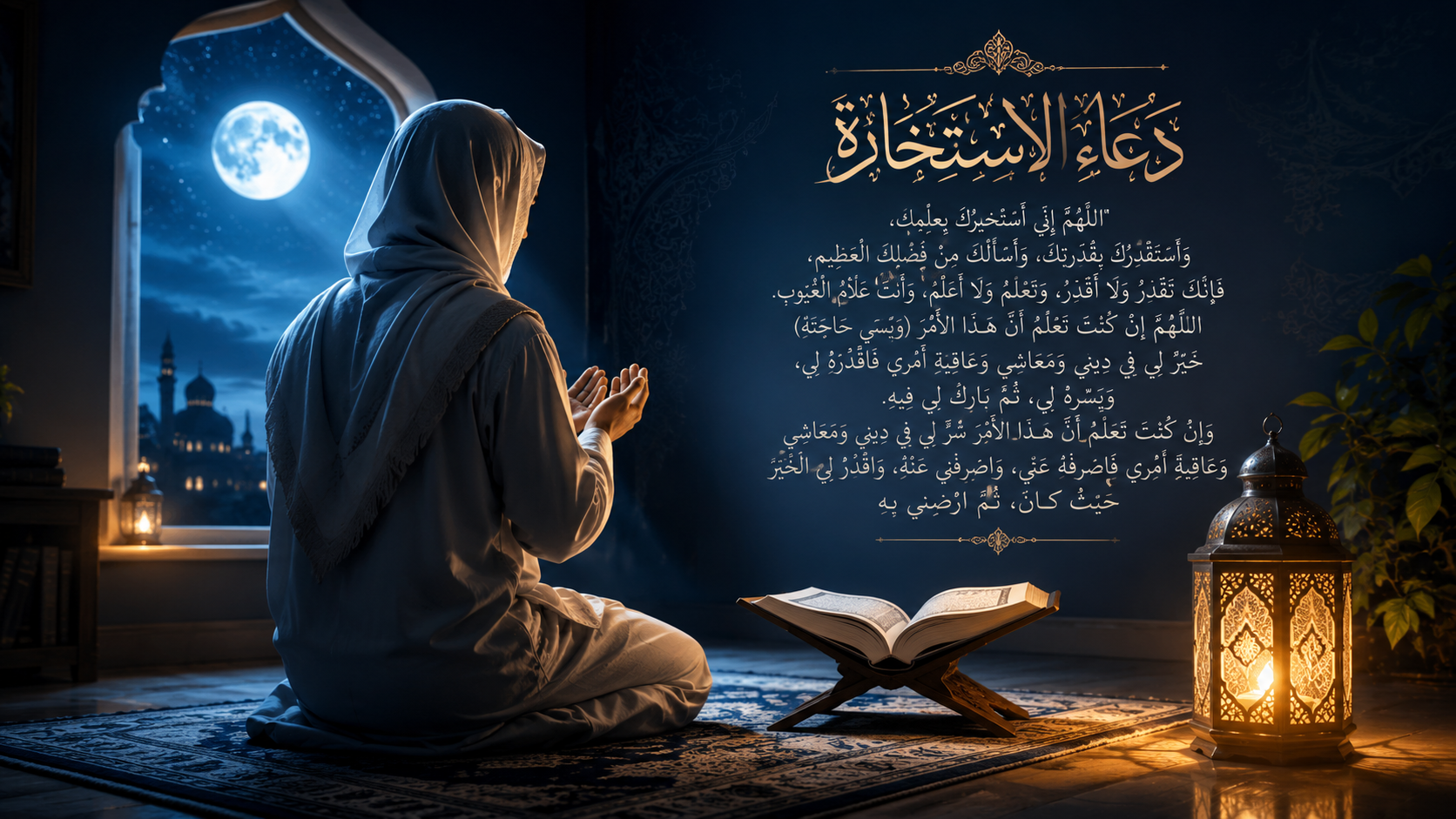
Dua e Istikhara in Arabic, Urdu and English _ Complete Guide
First, Understand What Istikhara Really Means
A lot of Muslims perform Istikhara their whole lives without fully understanding what it actually is. So before the dua, let us spend a moment on the meaning.
The word Istikhara comes from the Arabic root Khair which means goodness. So literally, Istikhara means “to seek goodness from Allah.” You are not asking Allah to show you a sign in a dream. You are not asking Him to make something happen. You are asking Him the One who knows everything about your past, present, and future to bring you toward what is truly good for you, even if you cannot see it yourself right now.
And that distinction matters a lot.
Jabir ibn Abdullah (RA) narrated:
“The Messenger of Allah ﷺ used to teach his companions Istikhara in all matters, just as he would teach them a Surah of the Quran.” Sahih Bukhari: 1166
Pay attention to the phrase “in all matters.” Not just marriage. Not just business. The Prophet ﷺ taught this dua for every situation where a Muslim faces uncertainty. That tells you how important and how broad this Sunnah really is.
Dua e Istikhara in Arabic
Here is the complete and authentic dua e istikhara in Arabic, exactly as recorded in Sahih Bukhari:
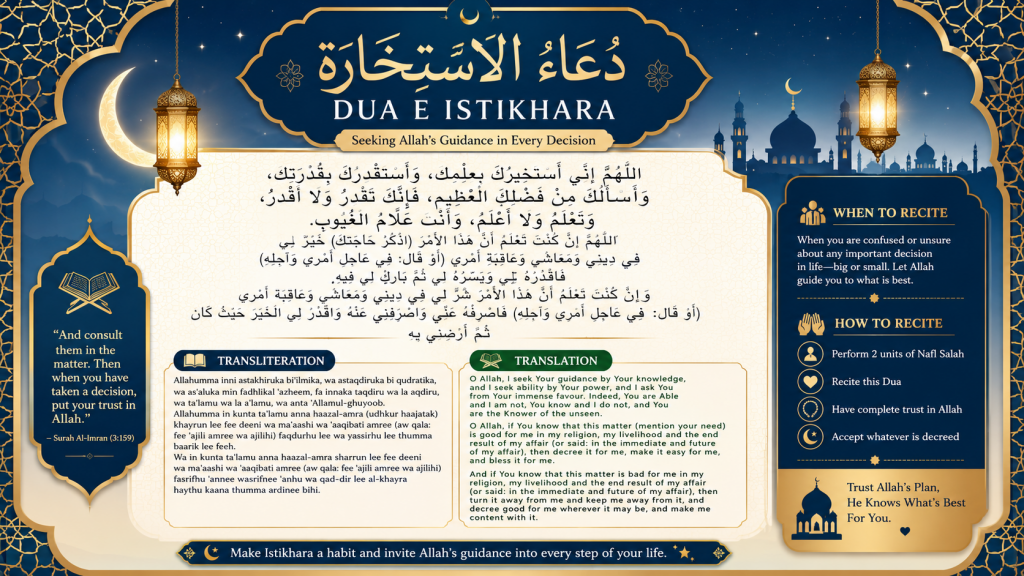
اللَّهُمَّ إِنِّي أَسْتَخِيرُكَ بِعِلْمِكَ، وَأَسْتَقْدِرُكَ بِقُدْرَتِكَ، وَأَسْأَلُكَ مِنْ فَضْلِكَ الْعَظِيمِ
فَإِنَّكَ تَقْدِرُ وَلَا أَقْدِرُ، وَتَعْلَمُ وَلَا أَعْلَمُ، وَأَنْتَ عَلَّامُ الْغُيُوبِ
اللَّهُمَّ إِنْ كُنْتَ تَعْلَمُ أَنَّ هَذَا الْأَمْرَ خَيْرٌ لِي فِي دِينِي وَمَعَاشِي وَعَاقِبَةِ أَمْرِي فَاقْدُرْهُ لِي وَيَسِّرْهُ لِي ثُمَّ بَارِكْ لِي فِيهِ
وَإِنْ كُنْتَ تَعْلَمُ أَنَّ هَذَا الْأَمْرَ شَرٌّ لِي فِي دِينِي وَمَعَاشِي وَعَاقِبَةِ أَمْرِي فَاصْرِفْهُ عَنِّي وَاصْرِفْنِي عَنْهُ وَاقْدُرْ لِي الْخَيْرَ حَيْثُ كَانَ ثُمَّ أَرْضِنِي بِهِ
Dua e Istikhara Transliteration (Roman English)
For brothers and sisters who are still learning to read Arabic, here is the full transliteration so you can read it phonetically:
Allahumma inni astakhiruka bi ‘ilmika, wa astaqdiruka bi qudratika, wa as’aluka min fadlikal azeem.
Fa innaka taqdiru wa laa aqdiru, wa ta’lamu wa laa a’lamu, wa anta ‘allaamul ghuyoob.
Allahumma in kunta ta’lamu anna haadhal amra — khayrun li fi deeni wa ma’aashi wa ‘aaqibati amri — faqdurhu li wa yassirhu li thumma baarik li feeh.
Wa in kunta ta’lamu anna haadhal amra — sharrun li fi deeni wa ma’aashi wa ‘aaqibati amri — fasrifhu ‘anni wasrifni ‘anhu, waqdur liyal khayra haythu kaana, thumma ardini bih.
Read it slowly. Do not rush. Let the words connect with your heart as you recite them.
Dua e Istikhara with Urdu Translation
For all the readers searching for dua e istikhara with Urdu here is the complete and clear Urdu translation so you can understand every word deeply:
اے اللہ! میں تیرے علم کے وسیلے سے تجھ سے بھلائی طلب کرتا ہوں، تیری قدرت کے ذریعے سے قوت مانگتا ہوں، اور تیرے عظیم فضل و کرم کا سوال کرتا ہوں۔
بے شک تو قدرت رکھتا ہے اور میں بے قدرت ہوں، تو جانتا ہے اور میں نہیں جانتا، اور تو تمام پوشیدہ باتوں کا جاننے والا ہے۔
اے اللہ! اگر تو جانتا ہے کہ یہ معاملہ میرے دین، میری زندگی اور میرے انجام کے اعتبار سے میرے لیے بہتر ہے، تو اسے میرے لیے مقدر فرما، اسے میرے لیے آسان بنا دے، اور پھر اس میں میرے لیے برکت عطا فرما۔
اور اگر تو جانتا ہے کہ یہ معاملہ میرے دین، میری زندگی اور میرے انجام کے اعتبار سے میرے لیے نقصاندہ ہے، تو اسے مجھ سے پھیر دے اور مجھے اس سے پھیر دے، اور میرے لیے بھلائی مقدر فرما جہاں بھی وہ ہو، اور پھر مجھے اس پر راضی کر دے۔
Dua e Istikhara in English Translation
Here is the complete dua e istikhara with translation in English. Read it slowly — every line carries deep meaning:
O Allah, I seek Your guidance by virtue of Your knowledge, and I seek ability through Your power, and I ask You from Your great bounty.
Indeed You have power and I have none, You know and I know not, and You are the Knower of all hidden things.
O Allah, if You know that this matter is good for me — in my religion, my livelihood and the outcome of my affairs — then ordain it for me, make it easy for me, and bless me in it.
And if You know that this matter is bad for me — in my religion, my livelihood and the outcome of my affairs — then turn it away from me and turn me away from it, and ordain for me what is good wherever it may be, and then make me pleased and content with it.
One thing to reflect on here — the dua does not say “give me what I want.” It says “give me what is good.” That is an entirely different prayer. That is surrender. That is Iman.
How to Perform Namaz e Istikhara – Full Step by Step
Let us now go through the complete method of Namaz e Istikhara step by step so there is no confusion:
Step 1 — Make Complete Wuzu
Start by performing a fresh and proper ablution. Ensure you are in a state of full purity before beginning the salah.
Step 2 — Make Your Niyyah (Intention)
Before starting, make a clear intention in your heart that you are offering two Rakaat of Nafl salah for Istikhara. You do not need to say it aloud — the intention in the heart is enough.
Step 3 — Pray Two Rakaat of Nafl Salah
Pray two Rakaat of voluntary (Nafl) prayer. In the first Rakaat after Surah Al-Fatiha, it is recommended to recite Surah Al-Kafirun. In the second Rakaat, recite Surah Al-Ikhlas. If you do not know these by heart, any Surah you know is acceptable.
Step 4 — After Salaam, Face the Qiblah
Once you complete the two Rakaats and say Salaam on both sides, stay seated or stand facing the Qiblah. First praise Allah (say Alhamdulillah), then send Salawat on the Prophet ﷺ (Durood Ibrahim), and then raise your hands to make dua.
Step 5 — Recite the Complete Dua e Istikhara
Now recite the full dua with complete focus, humility, and sincerity. When you reach the words “haadhal amr” (this matter), bring to mind clearly — or softly whisper — the specific situation you are seeking guidance about. Let that matter fill your heart in that moment.
Step 6 — Trust Allah and Move Forward
After finishing the dua, put your full trust in Allah and let go. Do not sit in anxiety waiting for a sign. Go about your life. Whatever path becomes easy and naturally opens up that is likely your answer. Whatever keeps closing, falling apart, or feeling wrong that is your answer too.
When Should You Make Dua e Istikhara?
Many people think Istikhara is only for marriage. That is a very limited understanding. The Prophet ﷺ said “in all matters.” Here are situations where this dua is highly recommended:

- Considering a marriage proposal — one of the most common reasons
- Starting a new job or accepting a transfer
- Opening a business or making a major investment
- Planning a significant journey or relocation
- Choosing a field of study or career path
- Making a major purchase like a house or property
- Any important life decision involving permissible choices
The key condition Istikhara is only for halal options. If something is clearly forbidden in Islam, there is no need for Istikhara. It is only when you are choosing between two or more permissible paths.
Common Mistakes People Make About Istikhara
Over generations, many cultural ideas have mixed into this beautiful Sunnah and confused people. Here are the most important mistakes to avoid:
Waiting Only for a Dream
This is the biggest misconception. Most people think they need to see a specific dream green means yes, red means no and wait for days. This has no authentic basis in any hadith. The Prophet ﷺ never mentioned dream colors as signs. If you see a dream, it may carry meaning, but it is not a requirement at all.
Asking Someone Else to Do It for You
Some people ask a local imam, a pious relative, or even someone online to “do Istikhara for them.” This goes completely against the spirit of the prayer. Istikhara is a personal conversation between you and Allah. No one else can stand in for you.
Doing It Without Thinking First
Istikhara is not a replacement for your brain. Islam asks you to think, consult wise people, weigh your options, and THEN turn to Allah. Using Istikhara as a shortcut to avoid thinking is not the Sunnah.
Only Trying Once and Giving Up
If you feel no clarity after one Istikhara, do not abandon it. Scholars widely agree that you can and should repeat it for three, five, or seven days if needed until your heart finds a direction.
Getting Upset When Doors Close
Sometimes after Istikhara, the very thing you wanted falls through. Plans break down. People say no. Circumstances change. Many Muslims get frustrated at this point. But understand that closed door IS the Istikhara working. Allah turned the harm away from you. The correct response is gratitude, not frustration.
The Deep Wisdom in This Dua
There is one phrase in this dua that is worth sitting with quietly. Right at the end, after asking Allah to ordain what is good you say “thumma ardini bih.” Which means: “and then make me pleased with it.”
You are not just asking Allah to choose for you. You are asking Him to put peace and contentment in your heart with whatever He chooses. That is a level of trust of Tawakkul that very few prayers express so directly.
This is why the scholars of Islam say that a believer who truly performs Istikhara and accepts the outcome will never carry lasting regret. Because they did not rely on their own limited knowledge. They handed the decision to Allah and then asked Him to make them happy with His answer.
That is not weakness. That is the highest form of strength a believer can have.
A Final Word_You Are Never Alone in Your Decision
Life’s crossroads can feel lonely. But the Muslim who knows Dua e Istikhara is never truly alone at those crossroads. You have a direct line to the One who created you, knows your future, loves you more than anyone else, and genuinely wants what is best for you.
Whether you came here searching for the dua e istikhara in Arabic, the dua e istikhara with Urdu translation, the dua e istikhara in English, or simply wanted to understand namaz e istikhara ki dua properly — we hope this guide gave you exactly what you needed.
Learn this dua by heart. Teach it to your children while they are young. Make it your habit every time you face uncertainty — big or small. Because a believer who brings their confusion to Allah, and then trusts His answer with a calm heart, has understood something truly beautiful about this Deen.
May Allah make every decision in your life easy, fill your path with Khair, and grant you a heart that is always content with His choices. Ameen.
1. What is the best time to perform Namaz e Istikhara?
The most virtuous time is during the last third of the night — the same time as Tahajjud salah — when Allah’s mercy is closest to His servants. However, Namaz e Istikhara can be performed at any valid prayer time during the day or night. Just avoid the three forbidden times: right after Fajr until the sun fully rises, at exact midday, and from after Asr until sunset. Other than those windows, any time is permissible.
2. Can a woman perform Dua e Istikhara during her menstrual cycle?
During her menstrual cycle, a woman cannot offer the two Rakaat of Nafl salah because prayer is not permissible at that time. However, she can absolutely recite the dua e istikhara on its own — without the prayer — because dua (supplication) is always allowed regardless of one’s state. Once her cycle ends and she performs ghusl, she can then offer the complete Namaz e Istikhara as well.
3. How many days should I repeat Istikhara if I still feel unsure?
There is no fixed number mentioned in any authentic hadith. However, the majority of Islamic scholars recommend repeating Dua e Istikhara for three to seven consecutive days if you do not feel clarity after the first time. Each time you perform it, bring full sincerity and an open heart. Do not go into it with a predetermined answer you are hoping for — that defeats the purpose entirely.
4. Is it true that you must see a dream after performing Istikhara?
No — this is entirely a cultural myth with no authentic Islamic foundation. The Prophet ﷺ never made dreams a condition or sign for Istikhara. Guidance after Istikhara can come in many forms — a feeling of ease or peace in your heart toward a decision, changing circumstances, clear obstacles on one path and smooth progress on another, or advice from trustworthy people that points you in a direction. Do not put your life on hold waiting for a dream that may or may not come.
5. Can a parent perform Istikhara on behalf of their child?
The complete Namaz e Istikhara — with its two Rakaats and full dua — is ideally performed by the person who is directly facing the decision. A parent can absolutely make sincere heartfelt dua asking Allah to guide their child toward what is best — and that dua is powerful and full of barakah. But the structured Istikhara prayer itself is meant to be a personal act of worship by the one involved in the matter. If the child is an adult, encourage them to perform it themselves.